

Command-Line Tools#
The ViennaRNA Package comes with a number of executable programs that provide command line interfaces to the most important algorithms implemented in RNAlib.
Find an overview of these programs and their corresponding manual pages below.
Main Programs#
RNA2Dfold
Compute MFE structure, partition function and representative sample structures of k,l neighborhoods
RNAaliduplex
Predict conserved RNA-RNA interactions between two alignments
RNAalifold
Calculate secondary structures for a set of aligned RNA sequences
RNAcofold
Calculate secondary structures of two RNAs with dimerization
RNAdistance
Calculate distances between RNA secondary structures
RNAdos
Calculate the density of states for each energy band of an RNA
RNAduplex
Compute the structure upon hybridization of two RNA strands
RNAeval
Evaluate free energy of RNA sequences with given secondary structure
RNAfold
Compute the minimum free energy structure and base pair probabilities for an RNA sequence.
RNAheat
Calculate the specific heat (melting curve) of an RNA sequence
RNAinverse
Find RNA sequences with given secondary structure (sequence design)
RNALalifold
Calculate locally stable secondary structures for a set of aligned RNAs
RNALfold
Calculate locally stable secondary structures of long RNAs
RNAmultifold
Compute thermodynamic properties for interaction complexes of multiple RNAs
RNApaln
RNA alignment based on sequence base pairing propensities
RNApdist
Calculate distances between thermodynamic RNA secondary structures ensembles
RNAparconv
Convert energy parameter files from ViennaRNA 1.8 to 2.0 format
RNAPKplex
Predict RNA secondary structures including pseudoknots
RNAplex
Find targets of a query RNA
RNAplfold
Calculate average pair probabilities for locally stable secondary structures
RNAplot
Draw RNA Secondary Structures in PostScript, SVG, or GML
RNApvmin
Calculate a perturbation vector that minimizes discrepancies between predicted and observed pairing probabilities
RNAsnoop
Find targets of a query H/ACA snoRNA
RNAsubopt
Calculate suboptimal secondary structures of RNAs
RNAup
Calculate the thermodynamics of RNA-RNA interactions
Additional Programs#
We include the following additional programs in our distribution of the ViennaRNA Package. Whether or not they are installed together with the ViennaRNA Package depends on its /configuration.
Analyse a distance matrix
Analyse a set of sequences of common length
Simulate kinetic folding of RNA secondary structures
Predict RNA folding trajectories
Compare RNA secondary structures via forest alignment
Calculate local minima from structures via gradient walks
Explore the RNA conformation space through sampling and other techniques
Utilities#
We also ship a number of small utilities, many of them to manipulate the PostScript files produced by the structure prediction programs RNAfold and RNAalifold.
Tip
Most of the Perl 5 utilities contain embedded pod documentation. Type e.g.
perldoc relplot.pl
for detailed instructions.
Tool Name |
Description |
|---|---|
ct2db |
Produce dot bracket notation of an RNA secondary structure
given as mfold
.ct file |
b2mt.pl |
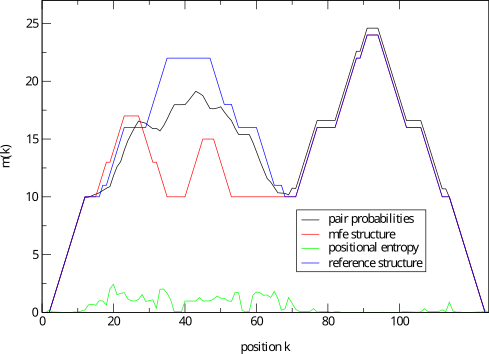
Produce a mountain representation of a secondary structure
from it’s dot-bracket notation, as produced by RNAfold.
Output consists of simple
x y data suitable as input to aplotting program. The mountain representation is a xy plot with
sequence position on the x-axis and the number of base pairs
enclosing that position on the y-axis.
Example: RNAfold < my.seq | b2mt.pl | xmgrace -pipe
|
cmount.pl |
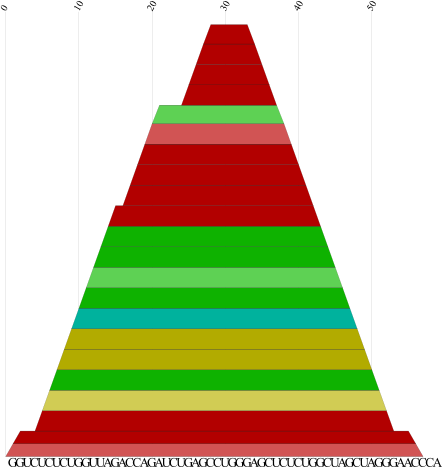
Produce a PostScript mountain plot from a color dot plot as
created by RNAalifold -p or
alidot -p. Each base pairis represented by a trapez whose color encodes the number of
consistent and compensatory mutations supporting that pair:
Red marks pairs with no sequence variation; ochre, green, turquoise,
blue, and violet mark pairs with 2,3,4,5,6 different types of pairs,
respectively.
Example: cmount.pl alidot.ps > cmount.ps

|
coloraln.pl |
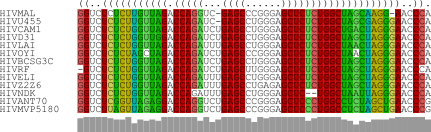
Reads a sequence alignment in
CLUSTAL format and a consensussecondary structure (which it extracts from a secondary structure
plot as produced by RNAalifold), and produces a postscript figure
of the alignment annotated using the consensus structure, coloring
base pair using the same color scheme as
cmount.pl, RNAalifoldand
alidot.Example: coloraln.pl -s alirna.ps file.aln > coloraln.ps
|
colorrna.pl |
Reads a consensus secondary structure plot and a color dot plot
as produced by RNAalifold -p, and writes a new secondary
structure plot in which base pairs a colored using the color
information from the dot plot.
Example: colorrna.pl alirna.ps alidot.ps > colorRNA.ps
|
mountain.pl |
Similar to
b2mt.pl, but produces a mountain plot from thepair probabilities contained in a PostScript dot plot. It write
3 sets of x y data, suitable as input for a plot program. The
first two sets containing the mountain representation from pair
probabilities and MFE structure, the third set is the
“positional entropy” a measure of structural well-definedness.
Example: mountain.pl dot.ps | xmgrace -pipe
|
refold.pl |
Refold using consensus structure as constraint |
relplot.pl |
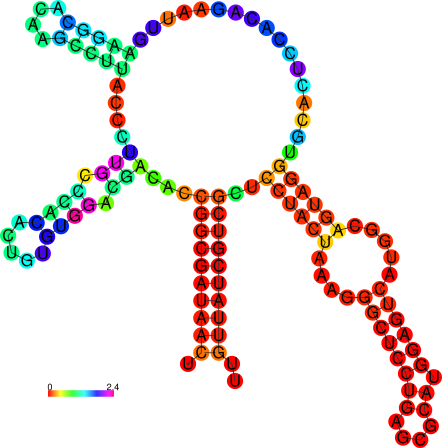
Reads a postscript secondary structure plot and a dot plot
containing pair probabilities as produced by RNAfold -p,
and produces a new structure plot, color annotated with reliability
information in the form of either pair probabilities or positional
entropy (default).
Example: relplot.pl foo_ss.ps foo_dp.ps > foo_rss.ps
|
rotate_ss.pl |
Reads a postscript secondary structure plot as produced by
RNAfold and produces a new rotated and/or mirrored
structure plot.
Example: rotate_ss.pl -a 30 -m foo_ss.ps > foo_new_ss.ps
|
switch.pl |
Design sequences that can adopt two different structure, i.e.
design RNA switches. The program will sample the set of sequences
compatible with two input structures in order to find sequences with
desired thermodynamic and kinetic properties. In particular it is
possible to specify two different temperatures such that structure
1 is favored at T1 and structure 2 at T2 to design temperature
sensitive switches (RNA thermometers). The desired height of the
energy barrier separating the two structures, thus determining
the refolding time between meta-stable states.
|
RNAdesign.pl |
Flexible design of multi-stable RNA molecules. An initially random
sequence is iteratively mutated and evaluated according to an
objective function (see Option:
--optfun). Whenever a betterscoring sequence has been found, the mutation is accepted, the
algorithm terminates once a local minimum is found. This script
makes heavy use of the
RNA::Design sub-package that comeswith the ViennaRNA Package
Perl 5 interface. |