

Free Energy Evaluation#
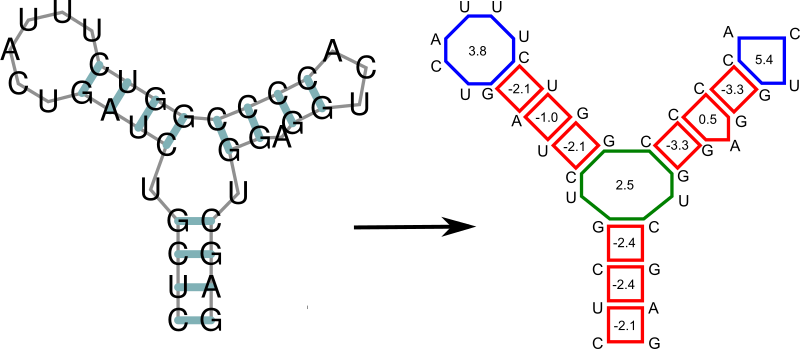
Under the Nearest Neighbor energy model secondary structures \(s\) are decomposed into individual loops \(L\) and the overall free energy \(E(s)\) of a structure is estimated as the sum of free energy contributions of the individual loops a structure is composed of, i.e.:
Here, we demonstrate how this is done and which parts of the
RNAlib API are dedicated to free energy evaluation.
Loop Decomposition#
Each base pair in a secondary structure closes a loop, thereby directly enclosing unpaired nucleotides, and/or further base pairs. Our implementation distinguishes four basic types of loops:
hairpin loops
internal loops
multibranch loops
exterior loop
While the exterior loop is a special case without a closing pair, the other loops are determined by the number of base pairs involved in the loop formation, i.e. hairpin loops are 1-loops, since only a single base pair delimits the loop. internal loops are 2-loops due to their enclosing, and enclosed base pair. All loops where more than two base pairs are involved, are termed multibranch loops.
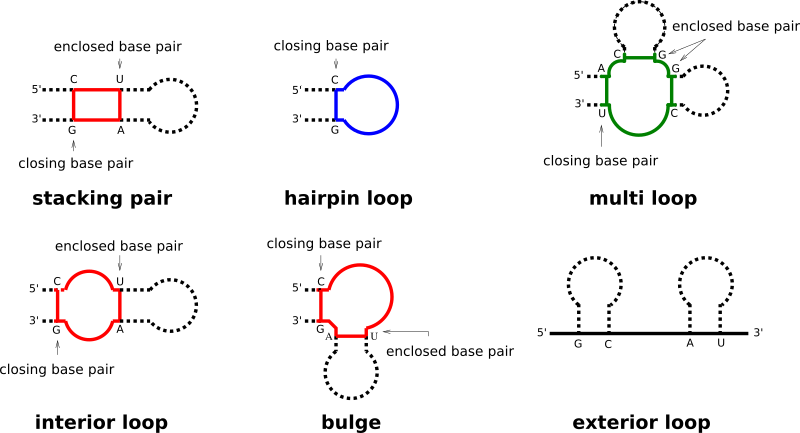
Any secondary structure can be decomposed into its loops. Each of the loops then can be scored in terms of free energy, and the free energy of an entire secondary structure is simply the sum of free energies of its loops.
Energy Parameters#
For secondary structure free energy evaluation we usually utilize the set of
thermodynamic Nearest Neighbor energy parameters also used in other software,
such as UNAfold and RNAstructure.
Available Parameter Sets#
While RNAlib already contains a compiled-in set of the latest
Turner 2004 Free Energy Parameters, we defined a file format that allows to
change these parameters at runtime. The ViennaRNA Package already comes with
a set of parameter files containing
Turner 1999 RNA parameters
Mathews 1999 DNA parameters
Andronescu 2007 RNA parameters
Mathews 2004 DNA parameters
See also
The Energy Parameters section provides a comprehensive overview of the related functions.
Salt Corrections#
The default Nearest Neighbor energy parameter set has been determined for monovalent salt conditions (in particular sodium ion concentrations) of \(1\,M\). To adapt the change in free energy for individual loops under different ion concentrations, we provide an approach taken from Einert and Netz [2011].
The implemented functions return correction terms in units of \(\text{dcal} \cdot \text{mol}^{-1}\).
See also
The Salt Corrections section provides a list of related functions.
Tip
To preserve some backward compatibility the RNAlib also provides functions to convert energy parameter files from the format used in version 1.4-1.8 into the new format used since version 2.0. See Converting Energy Parameter Files for details.
Fine-tuning of the Evaluation Model#
Evaluate Individual Loops#
To assess the free energy contribution of a particular loop \(L\) within a secondary structure, two variants are provided
The bare free energy \(E_L\) (usually in units of deka-calories, i.e. multiples of \(10 \text{cal} \cdot \text{mol}^{-1}\), and
The Boltzmann weight \(q = exp(-\beta E_L)\) of the free energy \(E_L\) (with \(\beta = \frac{1}{RT}\), gas constant \(R\) and temperature \(T\))
The latter is usually required for partition function computations.
See also
Have a look at the Energy Evaluation for Individual Loops section for an overview of the available implementations.
Evaluate Atomic Moves#
A set of functions is available to assess the change in free energy upon minimal structural changes, what we call atomic moves.
Here, atomic moves are not to be confused with moves of actual physical atoms. Instead, an atomic move is considered the smallest conformational change a secondary structure can undergo to form another, distinguishable structure. We currently support the following moves
Opening (dissociation) of a single base pair
Closing (formation) of a single base pair
Shifting one pairing partner of an existing pair to a different location
See also
The Energy Evaluation for Atomic Moves section provides an overview of the available implementations.
Evaluate Secondary Structures#
Several different functions to evaluate the free energy of a full secondary structure
under a particular set of parameters and the Nearest Neighbor Energy model are available
in RNAlib.
For most of them, two different forms of representations for the secondary structure may be used:
The Dot-Bracket string
A pair table representation
Furthermore, the evaluation functions are divided into basic and simplified variants,
where basic functions require the use of a vrna_fold_compound_t data structure
holding the sequence string, and model configuration (settings and parameters).
The simplified functions, on the other hand, provide often used default model settings that may be called directly with only sequence and structure data.
Finally, verbose variants exist for some functions that allow one to print the
(individual) free energy contributions to some FILE stream.
See also
An overview of the available functions can be taken from the Evaluation of Structures section.