

The RNA Folding Grammar#
Introduction#
To predict secondary structures composed of the four distinguished loop types
introduced in Free Energy Evaluation, all algorithms implemented in RNAlib
follow a specific recursive decomposition scheme, also known as the
RNA folding grammar, or Secondary Structure Folding Recurrences.
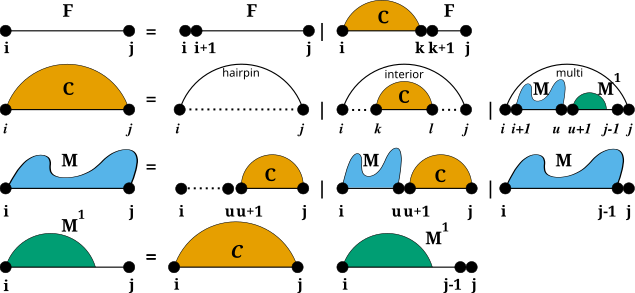
Compared to other RNA secondary structure prediction libraries, our implementation allows for a fine-grained control of the above recursions.
In particular, secondary structure constraints provide a very useful means to control whether and how structures are taken into account by a prediction algorithm and how they are evaluated. Here, we distinguish two groups: Hard Constraints and Soft Constraints.
While hard constraints directly influence the production rules used in the folding recursions by allowing, disallowing, or enforcing certain decomposition steps, soft constraints are used to change position specific contributions in the recursions by adding bonuses/penalties in form of pseudo free energies to certain loop configurations.
Note
Secondary structure constraints are always applied at decomposition level, i.e. in each step of the recursive structure decomposition, for instance during MFE prediction.
In contrast, some applications of RNA secondary structure prediction require an extension of the regular RNA folding grammar. For instance one would like to include proteins and other ligands binding to unpaired loop regions while competing with conventional base pairing. Another application might be that one may want to include the formation of self-enclosed structural modules, e.g. G-quadruplexes. For such applications, we provide a pair of additional domains that extend the regular RNA folding grammar: Structured Domains and Unstructured Domains.
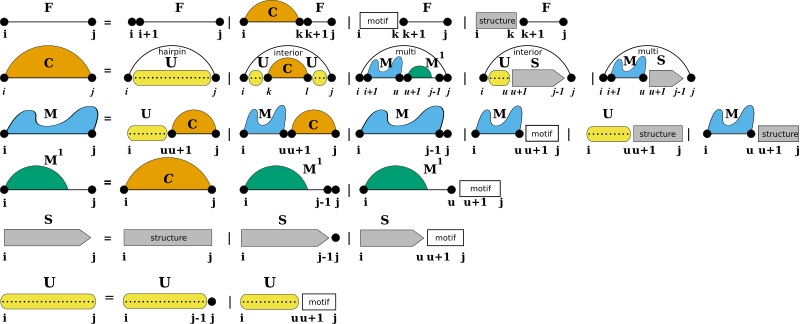
While unstructured domains are usually determined by a more or less precise
sequence motif, e.g. the binding site for a protein, structured domains are
considered self-enclosed modules with a more or less complex pairing pattern.
Our extension with these two domains introduces two production rules to fill
additional dynamic processing matrices S and U where we store the
pre-computed contributions of structured domains (S), and unstructured
domains (U).
See also
/ligands/unstructured_domains. Secondary Structure Constraints lists all related constraints related API symbols.
Hard Constraints#
Hard constraints as implemented in our library can be specified for individual loop types, i.e. the atomic derivations of the RNA folding grammar rules. Hence, the pairing behavior of both, single nucleotides and pairs of bases, can be constrained in every loop context separately. Additionally, an abstract implementation using a callback mechanism allows for full control of more complex hard constraints.
The following option flags may be used to constrain the pairing behavior of single, or pairs of nucleotides:
VRNA_CONSTRAINT_CONTEXT_ENFORCEVRNA_CONSTRAINT_CONTEXT_NO_REMOVE
See also
A full list of available functions and data structures for hard constraints can be found under Hard Constraints API.
Soft Constraints#
Soft-constraints are used to change position specific contributions in the recursions by adding bonuses/penalties in form of pseudo free energies to certain loop configurations.
For the sake of memory efficiency, we do not implement a loop context aware version of soft constraints. The static soft constraints as implemented only distinguish unpaired from paired nucleotides. This is usually sufficient for most use-case scenarios. However, similar to hard constraints, an abstract soft constraints implementation using a callback mechanism exists, that allows for any soft constraint that is compatible with the RNA folding grammar. Thus, loop contexts and even individual decomposition rules can be addressed separately for maximum flexibility in soft-constraints application.
Soft constraint callback functions will always be notified about the type of decomposition that is happening, and the corresponding delimiting sequence positions. The following decomposition steps are distinguished, and should be captured by the user’s implementation of the callback:
See also
High-level interfaces that build upon the soft constraints framework can be obtained by the implementations in the submodules:
/modified_bases
/probing_data
/probing/SHAPE
/ligands/constraints
An implementation that generates soft constraints for unpaired nucleotides by minimizing the discrepancy between their predicted and expected pairing probability is available in submodule /probing/perturbation.
A full list of available functions and data structures for soft constraints can be found under Soft Constraints API.
Unstructured Domains#
Unstructured domains appear in the production rules of the RNA folding grammar wherever new unpaired nucleotides are attached to a growing substructure (see also Lorenz et al. [2016]):
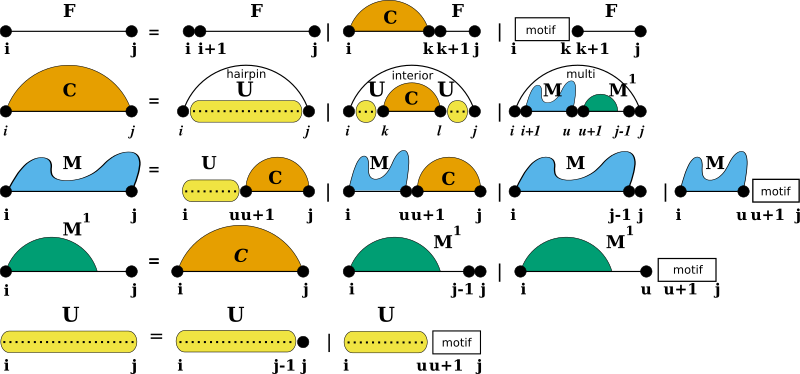
The white boxes represent the stretch of RNA bound to the ligand and represented
by a more or less specific sequence motif. The motif itself is considered unable
to form base pairs. The additional production rule U is used to precompute
the contribution of unpaired stretches possibly bound by one or more ligands.
The auxiliary DP matrix for this production rule is filled right before
processing the other (regular) production rules of the RNA folding grammar.
Implementation#
Our implementation provides the tools to add and modify unstructured domains to the production rules of the RNA folding grammar. Usually this functionality is utilized for incorporating ligand binding to unpaired stretches of an RNA.
Warning
Although the additional production rule(s) for unstructured domains as descibed here are always treated as segments possibly bound to one or more ligands, the current implementation requires that at least one ligand is bound. The default implementation already takes care of the required changes, however, upon using callback functions other than the default ones, one has to take care of this fact. Please also note, that this behavior might change in the future such that the decomposition schemes as shown above comply with the actual implementation.
A default implementation allows one to readily use this feature by simply adding sequence motifs and corresponding
binding free energies with the function vrna_ud_add_motif() (see also /ligands/unstructured_domains).
The grammar extension is realized using a callback function that
evaluates the binding free energy of a ligand to its target sequence segment (white boxes in the figures above), or
returns the free energy of an unpaired stretch possibly bound by a ligand, stored in the additional
UDP matrix.
The callback is passed the segment positions, the loop context, and which of the two above mentioned
evaluations are required. A second callback implements the pre-processing step that
prepares the U DP matrix by evaluating all possible cases of the additional production rule.
Both callbacks have a default implementation in RNAlib, but may be over-written by a
user-implementation, making it fully user-customizable.
For equilibrium probability computations, two additional callbacks exist. One to store/add and one to retrieve the probability of unstructured domains at particular positions. Our implementation already takes care of computing the probabilities, but users of the unstructured domain feature are required to provide a mechanism to efficiently store/add the corresponding values into some external data structure.
For the sake of flexibility, each of the domains is associated with a specific data structure serving as an abstract interface to the extension. The interface uses callback functions to
pre-compute arbitrary data, e.g. filling up additional dynamic programming matrices, and
evaluate the contribution of a paired or unpaired structural feature of the RNA.
Implementations of these callbacks are separate for regular free energy evaluation, e.g. MFE prediction, and partition function applications. A data structure holding arbitrary data required for the callback functions can be associated to the domain as well. While RNAlib comes with a default implementation for structured and unstructured domains, the system is entirely user-customizable.
See also
The available API can be viewed in detail here: Unstructured Domain API
Structured Domains#
Usually, structured domains represent self-enclosed structural modules that exhibit a more or less complex base pairing pattern. This can be more or less well-defined 3D motifs, such as G-Quadruplexes, or loops with additional non-canonical base pair interactions, such as kink-turns.
Note
At the time of writing, our implementation only provides the specialized case of G-Quadruplexes.
See also
The available API can be viewed in detail here: Structured Domains API
Extending the RNA Folding Grammar#
The RNA folding grammar can be easily extended by additional user-provided
rules. For that purpose, we implement a generic callback-based machinery, that
allows one to add rules to the existing decomposition stages F, C, M,
and M1. If such an extension is not sufficient, users may even extend the
grammar by arbitrary additional derivations.
Additional rules can be supplied for both, MFE and partition function computations. Here, a set of two callback functions must be provided, one for the inside, and another for the outside recursions. The functions will then be called at appropriate steps in the recursions automatically. Each function will be provided with a set of parameters for the decomposition step and a user-defined data pointer that may point to some memory storing any additional data required for the grammar rule.
See also
The detailed API for this mechanism can be found in Extending the Folding Grammar